Baby health care plays a vital role in the baby’s development.
Giving all the essential nutrients required for the growth of your baby is not considered as complete health care, protecting your child against certain diseases is also important while taking care of your baby health.
Vaccination refers to a process of giving a vaccine (injection or drops) to protect the body against diseases. It is a safe and effective way of defending the harmful infections before it attacks. So, vaccines are one of the essential needs of your baby health care routine.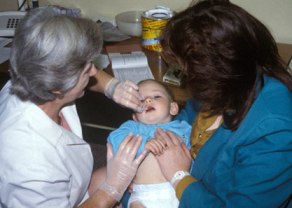
On the other hand, most of us think immunization is nothing but vaccination. However, there is a slight difference between these two.
Vaccination is the term used to refer the act of giving a vaccine where as immunization is the term referring to the process of giving vaccine and becoming resistant to the disease due to the vaccine.
The best way to maintain your baby health in good condition is to provide the vaccines on time according to the age. Your baby requires vaccination starting from the birth to the age of eighteen years.
From birth to two weeks of age, the baby should be given B.C.G (Tuberculosis), Polio (zero polio) and Hepatitis B (first dose). During your baby’s 1.5 months, give first dose of D.T.P, Polio (first dose), Hepatitis B (second Dose), and Haemophilus influenzae type B (first dose).
At the age of 2.5 months, give your baby the second dose of D.T.P vaccine, second dose of Polio vaccine, and Haemophilus influenzae type B (second dose).
At 3.5 months, give the third dose of D.T.P, Polio as well as Haemophilus influenzae type B vaccine to your baby. However, the third dose of Hepatitis B should be given at six months of age.
During ninth month of your child, give measles vaccine and the next dose of Polio. Once your baby completes one year, give chicken pox vaccine to your baby.
At fifteen months of age, M.M.R (Measles, Mumps and Rubella) vaccine is most essential for your baby. During eighteen months of age, give D.T.P booster, Polio-booster, as well as Haemophilus influenzae type B Booster.
At two years of age, typhoid and Hepatitis A Vaccine is must to prevent the baby from typhoid and Hepatitis A virus. At five years of age, give D.T (Diptheria-Tetanus) Vaccine. On the other hand, at ten years of age, give T.T (Tetanus Toxoid) Vaccine
Before the baby gets eighteen years, give T.D (Tetanus-Diptheria), TDaP vaccine to your child.
In addition to these common vaccines, you can give Japanese B Encephalitis, Pneumococcal polysaccharide vaccine (PPV), Meningococcal conjugate vaccine to your child as part of your baby health care regimen.
On the other hand, for a dog bite, rabies is the best vaccine to prevent your child from serious conditions.
Some of these vaccines may cause side effects: Low grade fever, Soreness, swelling and redness in the injected area. However, these side effects can disturb the baby health for a short time. Consult your doctor, if the baby health remains the same for longer period.
The food and materials that babies are exposed to also have an importance in keeping your baby healthy. Organic food that is grown without the use of pesticides is highly recommended, both for babies and adults. In general, consuming organic products (such as organic baby clothing) reduces exposure to harmful materials and can have a positive effect on your baby’s health.